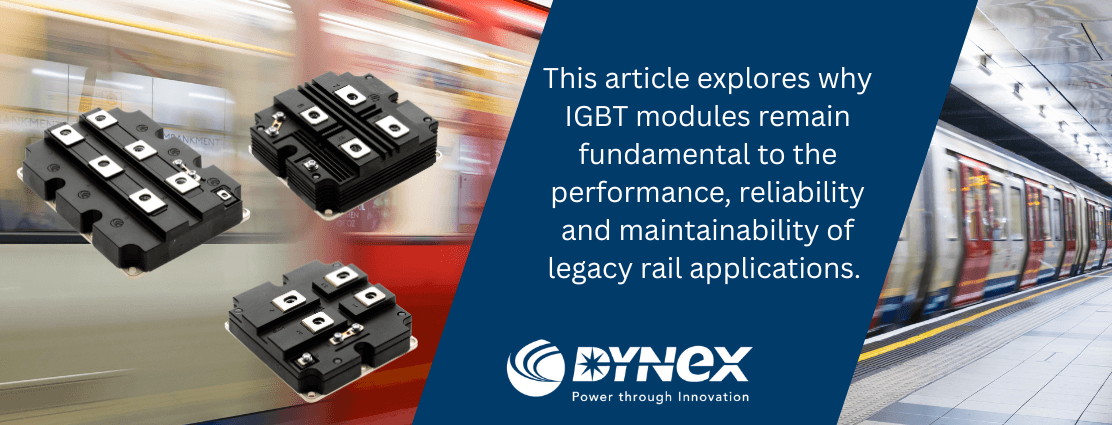
 Despite increasing industry attention on wide bandgap devices such as SiC MOSFETs, silicon-based Insulated Gate Bipolar Transistor (IGBT) modules continue to play a critical role in legacy rail applications. Rail traction and auxiliary systems are characterised by long design lifecycles, conservative change management, and stringent certification requirements. As a result, IGBT technology remains deeply embedded within installed fleets and supporting infrastructure, where performance, robustness and predictability outweigh the benefits of adopting newer device technologies.
This article looks at the technical reasons why IGBT modules remain essential to legacy rail systems, with particular focus on reliability, electrical performance, thermal behaviour and obsolescence management.
Rail system design constraints and legacy platforms
Trains and associated power electronics are typically designed for operational lifetimes exceeding 30 years. Traction converters, auxiliary inverters and onboard power supplies are qualified as complete systems, with semiconductor devices forming a critical and tightly integrated element of the overall design.
From an engineering perspective, replacing the power semiconductor technology in an existing platform is rarely a drop-in exercise. Changes in switching speed, loss distribution, dv/dt, gate drive requirements and protection strategies can have far-reaching implications such as thermal design and cooling capacity. For these reasons, legacy rail platforms continue to rely on proven IGBT module technologies that are well understood and fully characterised within the system.
Electrical performance characteristics of IGBT modules
IGBT modules offer a balanced compromise between conduction losses and switching losses at the voltage and current levels commonly used in rail applications (typically 1.7 kV to 6.5 kV modules). Their predictable switching behaviour and established Safe Operating Area make them particularly suitable for high-power traction and auxiliary converters.
Key IGBT advantages include:
- High current handling capability with robust short-circuit withstand time
- Controlled switching, enabling manageable dv/dt and di/dt levels
- Compatibility with established gate drive architectures
- Well-defined failure modes, supporting proven protection strategies
In legacy traction systems, where converter topologies and control schemes were optimised around IGBT behaviour, these characteristics are important to maintaining stable and reliable operation.
Thermal performance and packaging considerations
Thermal management is a dominant design constraint in rail power electronics. IGBT modules used in legacy applications are typically housed in robust industrial packages designed to withstand mechanical vibration, shock and repeated thermal cycling.
From a thermal engineering standpoint, IGBT modules offer:
- Large silicon die areas with predictable thermal impedance
- Stable solder and bond-wire technologies with known wear-out mechanisms
- Compatibility with liquid- and air-cooled heat sink designs already deployed in service
Decades of field data allow engineers to model junction temperature swings, lifetime consumption and maintenance intervals with a high degree of confidence. An important advantage when extending the service life of ageing fleets.
Reliability, lifetime modelling and field-proven performance
One of the strongest technical arguments for continued use of IGBT modules in legacy rail systems is the availability of long-term reliability data. Failure mechanisms such as bond-wire fatigue and solder layer degradation are well understood, enabling accurate lifetime modelling based on mission profiles.
For operators undertaking life-extension or refurbishment programmes, retaining IGBT-based designs allows existing reliability models and maintenance strategies to remain valid, reducing technical uncertainty and operational risk.
Obsolescence management
As original components reach end-of-life, obsolescence becomes a key technical and commercial risk. In rail applications, redesigning a traction converter to accommodate a new semiconductor technology can trigger extensive revalidation and re-certification.
Specialist IGBT suppliers mitigate this risk by providing long-term manufacturing continuity and support for low- to medium-volume production typical of rail programmes.
From an engineering perspective, this continuity enables direct replacement without changes to mechanical interfaces, gate drive circuitry or thermal design, significantly reducing validation effort.
Rail power electronics must comply with demanding standards covering electrical, thermal and environmental performance, and related railway-specific requirements. Any modification to the semiconductor devices used within a qualified system can necessitate partial or full requalification.
By maintaining the use of proven IGBT modules with established qualification histories, engineers can minimise the scope of re-testing and ensure continued compliance without introducing unnecessary technical risk.
Dynex Semiconductor: supporting legacy rail industry
Within the context of legacy rail applications, Dynex brings specific strengths that align closely with the technical and lifecycle demands of the industry. With decades of experience in high-power semiconductor design and manufacture, Dynex has established a strong heritage in supplying IGBT modules for traction and auxiliary power systems operating in demanding rail environments.
Key Dynex strengths relevant to legacy rail industry include:
- Dynex specialises in supporting products over extended lifetimes, aligning with the 25–30 year service expectations of rail systems.
- High-voltage, high-power capability of Dynex IGBT modules cover the ranges commonly used in rail traction and infrastructure applications, with designs optimised for robustness and reliability rather than short-term performance gains.
- Process stability and consistency in IGBTmanufacturing ensures parametric stability, which is critical when replacing devices in qualified and field-proven systems.
- Dynex focuses on replacement and continuation solutions that minimise system-level impact, avoiding unnecessary redesign, revalidation and re-certification.
- Close collaboration with rail OEMs and integrators enables Dynex to support application-specific requirements such as thermal cycling endurance, vibration resistance and harsh operating conditions.
These capabilities make Dynex a trusted partner for operators and OEMs seeking to extend the life of existing rail assets while maintaining technical integrity and regulatory compliance.
While future rail platforms may increasingly adopt alternative semiconductor technologies, the transition should be aligned with system-level redesign cycles. In this context, IGBT modules act as a stable technology, supporting legacy platforms while enabling gradual evolution rather than disruptive change.
In summary, from an engineering standpoint, IGBT modules remain fundamental to the performance, reliability and maintainability of legacy rail applications. Their well-characterised electrical behaviour, proven thermal robustness and extensive field data make them ideally suited to long-life rail applications.
By combining proven IGBT technology with long-term manufacturing stability and rail-specific expertise, Dynex plays a key role in sustaining legacy rail systems worldwide. As the rail industry balances innovation with the realities of installed fleets, strong technical support for legacy IGBT modules remains essential to ensuring safe, reliable and cost-effective operation over extended service lifetimes.